Build a Garden Routine You Can Keep
Make garden visits easier to manage by observing first, keeping useful notes, and choosing care tasks according to the plant and its conditions.
Make garden visits easier to manage by observing first, keeping useful notes, and choosing care tasks according to the plant and its conditions.
Habits · 8 min read
You arrive at the windowsill to water a basil pot, then spot a fallen leaf and a seed packet you meant to open. A few minutes later, you are juggling unrelated jobs without knowing which one matters most. A steady garden routine gives each visit a purpose: notice what changed, record the useful details, and choose a response that suits the plant and its conditions.
The goal is not to keep every plant busy or to follow a rigid schedule. It is to make decisions from what you can observe, rather than from habit alone. The same approach can help with a windowsill, a few containers, or a shared plot, though the right care varies by plant, growing medium, weather, and growing conditions.
Choose a check-in that fits your week
Pick a regular moment for a fuller review, such as after a weekend breakfast or when you return home on a chosen day. Attach the visit to something already in your routine instead of waiting for a perfectly free afternoon. Keep the commitment modest: the point is to inspect and decide, not to complete every task in sight.
Make room for exceptions. A pot knocked over or a plant showing sudden distress may need attention before the next planned visit. Treat that as a reason to inspect the specific problem, not as a signal to take on every other job nearby.
Observe before watering or pruning
Begin with a slow look across the garden. Notice changes in leaves, stems, flowers, containers, and the area around them. Check for practical clues such as a blocked drainage opening or water standing in a saucer. Then inspect the growing medium where appropriate: a dry-looking surface does not necessarily mean the root area is dry. A finger or wooden skewer can help you check below the surface, used carefully to avoid disturbing roots.
Watering needs differ among plants and can shift with container size, growing medium, light, temperature, and recent rain. Do not use one rule for every pot. Check the plant’s care information and the condition of its growing medium before watering; if you are unsure, wait and inspect again rather than adding water just because it is the scheduled day. Some plants also need their growing medium to dry more between waterings than others.
Pruning also depends on the plant and the reason for the cut. Removing a damaged or diseased part may be appropriate, but cutting healthy growth can affect flowering or plant shape. Check reliable care guidance for the plant before making a substantial cut. In a shared plot, confirm the boundary and the group’s agreement before touching plants or changing their care.
Follow the same route at each review, such as moving from the windowsill to the containers by the door. A repeatable route helps you cover the whole space without letting the most noticeable plant consume the visit. Focus on plant conditions and the specific care decisions at hand, rather than turning the check-in into a broad survey of the surrounding space.
Keep notes that help you decide
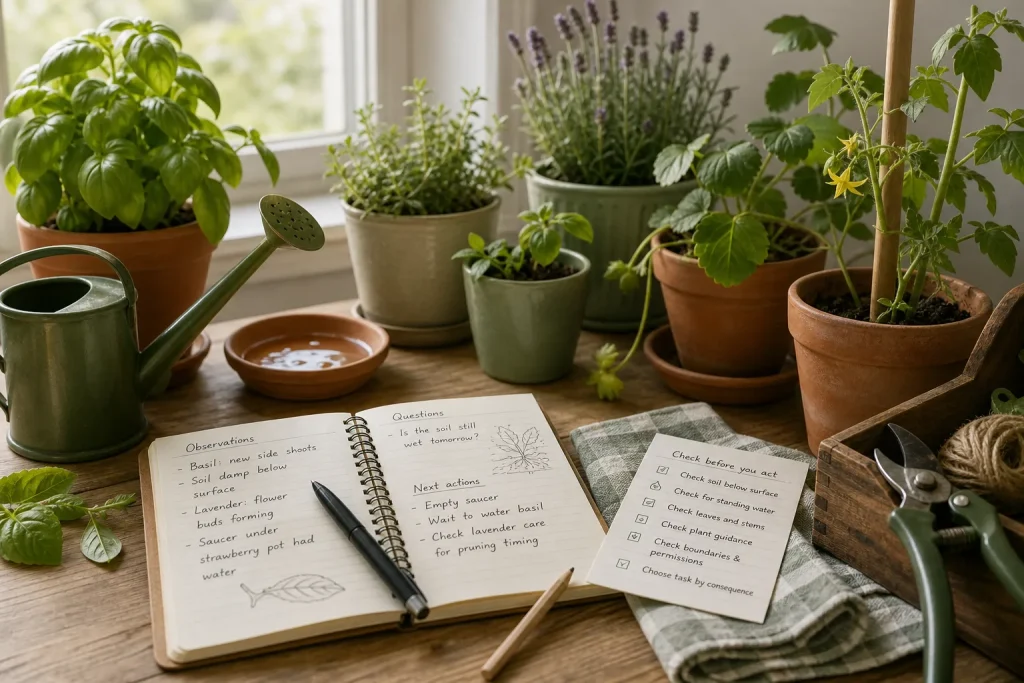
Use a pocket notebook, phone note, or card near your watering can. Write observations in concrete language: “basil leaves have new side shoots” or “growing medium damp below the surface.” Keep interpretations separate. “Lower leaves yellow” is an observation; “needs fertilizer” is a possible explanation that still needs checking.
If you are uncertain, record a question for the next visit: “Is the growing medium still wet tomorrow?” Include dates only when they help you compare conditions or remember an unfinished task. In a shared plot, use the group’s agreed channel or common notebook to record actions clearly, so another gardener can see what happened.
Choose tasks by consequence and plant need
After observing and recording, consider what could happen if each task waits. A plant with a care need that cannot reasonably wait deserves attention before a cosmetic job. But do not label watering urgent from surface appearance alone, and do not assume yellow leaves call for fertilizer. Check the plant’s guidance and the growing medium; when the cause is unclear, observing again may be the best next task.
Use these checks to make the next decision. Each item links an observable condition to an action and an alternative:
- Check the growing medium below the surface: if it is dry and the plant’s care guidance calls for watering, water the root area; if it is damp or the plant needs a drier interval, wait and inspect again.
- Check for water standing in a saucer: if water is pooling, empty it when appropriate for the plant; if the saucer is dry, leave it and continue the inspection.
- Check a yellowing leaf’s position and pattern: if the change is limited and the cause is unclear, record it and look for a pattern before feeding; if damage is spreading or the plant is declining, consult plant-specific care guidance before intervening.
- Check whether a stem or leaf is damaged: if it is clearly broken or diseased and the plant’s care guidance supports removal, use clean snips for the affected part; if it is healthy growth or you are unsure, leave it in place and check first.
- Check the plant label or care notes before a substantial cut: if they support pruning at this time, make only the intended cut with clean tools; if timing or technique is unclear, defer the cut and seek plant-specific guidance.
- Check permission and boundaries in a shared bed: if the task is assigned and agreed, do only that work and record it; if it is not agreed or the boundary is uncertain, pause and ask the group.
Consider effort and preparation as well. If a job needs potting mix, a suitable container, or permission for shared-space work, note that dependency instead of rushing into an incomplete version. Choose the clearest necessary task for the time available, and leave lower-priority work for a later review.
Finish the task and record what remains
Gather only what the chosen job needs. For watering, that may be a watering can and a way to check the growing medium. For an approved pruning task, it may be clean snips and a place to put removed material. Do not remove healthy growth or apply a treatment simply to make the garden look finished.
After acting, check the immediate result. Water the root area in a way that suits the plant and container, allowing excess to drain where appropriate. If the water runs straight through or remains pooled, pause and consider whether the growing medium or drainage needs attention rather than repeatedly adding water. After pruning, stop at the intended cut.
Before leaving, put tools away and update your note with what you did and what remains uncertain. “Checked basil below the surface; it was dry, watered according to its care notes; inspect again next visit” is more useful than “done.” In a shared space, record the action where others can find it.
Work through a hypothetical balcony visit
Starting inputs: Imagine a gardener with a basil pot, a container of leafy greens, and a flowering plant. For this invented example, the basil’s care label says to water when the growing medium begins to dry, while the gardener’s notes advise allowing the leafy greens’ medium to remain evenly moist. The gardener has a phone note, a watering can, and clean hand snips. These details are hypothetical, not universal care directions.
Step one: The gardener follows the same route from the door to each pot and records three observations: the basil’s medium feels dry below the surface; the greens’ medium feels damp; one flower has faded. The gardener checks the labels before deciding what any observation means.
Step two: The basil’s dry medium matches its own care note, so the gardener waters at the root area and watches the excess drain. The greens remain untouched because their medium is already moist. The faded flower is not a pressing problem, so the gardener checks the flowering plant’s care information before deciding whether and when to remove it.
Result and tradeoff: The gardener has acted on a plant-specific reason rather than watering every pot on the same schedule. The faded flower may remain until the next suitable visit, but the gardener avoids an unnecessary cut and records what to check next time. If the basil’s medium is still damp at a later check, the gardener waits instead of following a fixed watering routine.
Adjust the routine when care needs change
Use your notes to see whether the check-in still helps. New plants, changing indoor conditions, or a shift in who cares for a shared bed may call for a different route or a clearer record. If one plant’s care guidance calls for closer observation, add a reminder for that plant rather than expanding every garden visit.
If you miss a planned check-in, resume when convenient. Inspect the plants again before acting on an old task list; conditions may have changed. Keep only the routine elements that help you make sound decisions, such as a familiar inspection route, a short note, and a clear reason for each task.
A useful garden visit does not have to end with a tool in your hand. Sometimes the best outcome is a plant-specific action; sometimes it is a note to check a condition again before changing anything. That distinction helps keep care deliberate, proportionate, and easier to return to.