Plan a Balcony Garden Around Its Usable Space
Map everyday routes, drainage, exposure and building constraints before choosing containers, so a balcony garden fits the space without obstructing its use.
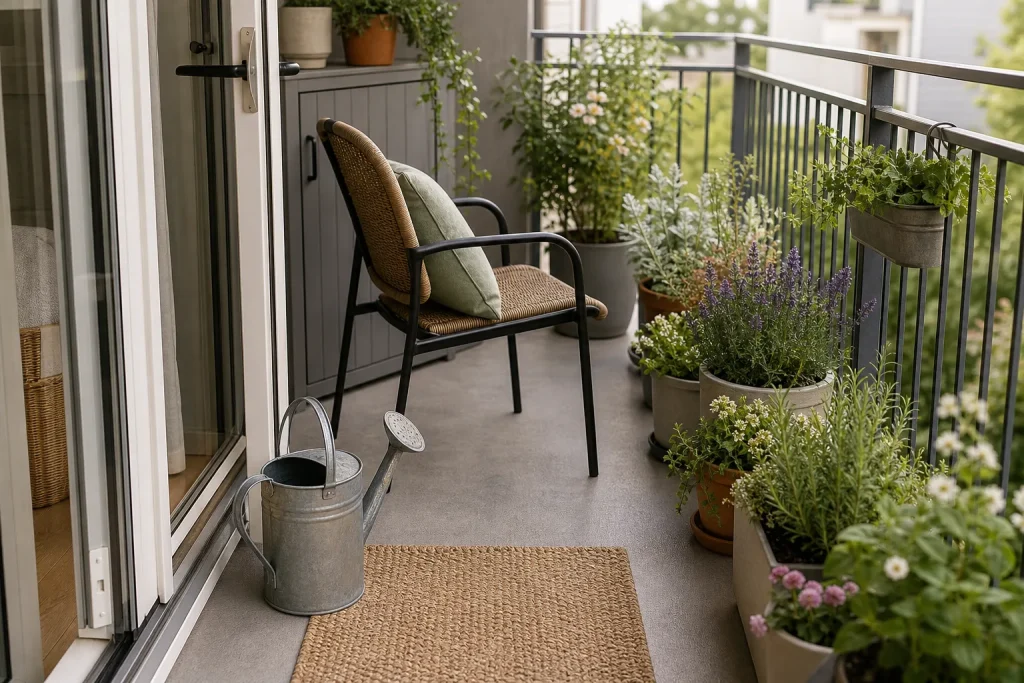
Map everyday routes, drainage, exposure and building constraints before choosing containers, so a balcony garden fits the space without obstructing its use.
Spaces · 8 min read
A watering can sits beside the balcony door, a chair is pulled back from the railing, and a row of pots narrows the route between them. This is a familiar sign that a balcony garden has been planned around containers rather than around the space people need to use. A better plan starts with the balcony’s access, surfaces and constraints, then identifies planting spots that do not compete with them.
Usable space is more than the open floor shown on a plan. It includes the path to the door, room to turn or pull out a chair, access to drains and utility fixtures, and the space needed to tend plants. Some questions, particularly those about structural capacity, attachments and drainage, depend on the building and local rules. Check with the property manager or an appropriately qualified professional before making assumptions about them.
Map the balcony’s fixed features and access
Sketch the balcony as it is. Mark the door and its swing, fixed storage, drain openings, railings, wall-mounted fixtures and existing furniture. Draw the route people use to reach a chair, drying rack or other everyday destination. This route may bend around furniture; it still needs to remain usable.
Mark the places where people stand, sit or need to reach equipment. A chair needs room to move, and a door needs room to open. If the balcony is shared, ask the other users which furniture and access points must stay available. A layout that blocks another person’s usual route is not a workable layout.
Use three labels on the sketch: keep clear for door swings, walking routes and access to drains or fixtures; moveable for items that can shift when needed; and possible planting for remaining locations. Before buying a pot, trace its footprint on paper or cut a cardboard template. Set the template in the proposed location and walk the route. If it overlaps a keep-clear area, choose a smaller or different placement.
Resolve building and drainage constraints first
A container can fit on the floor and still be unsuitable for a balcony. Containers, damp growing medium, water and mature plants all add load. The amount a particular balcony can support depends on its construction and condition, so do not infer capacity from appearance or from the fact that another resident has pots. Ask the property manager for the applicable guidance and consult a qualified building professional if capacity or installation requirements remain unclear.
Apply the same caution to attachments. Do not fasten a planter, screen, trellis or hook to a railing or wall unless the building permits that method and the attachment is suitable. A freestanding container kept inside the balcony boundary may be an alternative, but it still needs a stable place that does not obstruct movement.
Check where water from containers could go. Keep drain openings accessible, and do not set saucers where they can spill into a walking route when a pot is moved. Water should not drip onto a neighbor’s balcony or collect where people walk. For restrictions on runoff, exterior fixtures or watering, ask the property manager or the relevant local authority. If the route of excess water is uncertain, resolve that before placing containers.
Compare planting spots by access and exposure
Assess each possible spot separately. A railing-side area may be bright but exposed, while a corner near the wall may be shaded or sheltered. Notice when direct light reaches each proposed location and whether nearby buildings, glass, masonry or metal change its conditions. A simple note such as “morning light, shade later” is more useful for choosing a location than labelling the entire balcony sunny.
Notice wind at the places where pots would stand. Gusts can buffet tall stems and shift lightweight containers. A sheltered spot may suit a delicate plant better; an exposed spot calls for a stable arrangement and plants suited to its conditions. Do not add a screen as a quick fix without checking permission and secure installation, because a barrier can catch wind.
Check that you can reach every proposed container from inside the balcony. If watering or pruning would require leaning over a railing, choose another location. For a spot that is hard to reach, a cardboard template can help assess whether a container would be accessible before it is filled. If it would block a route or require unsafe leaning, leave the spot unplanted.
Choose container shapes that keep routes open
Container shape affects how the balcony functions. Several compact pots placed together along a wall may preserve a clear route, while wide pots scattered through the middle can interrupt it. A long trough can make use of a narrow edge, but only if it leaves drains, railings and required access unobstructed.
Consider stability as well as footprint. A tall, narrow pot takes up little floor area but may be more vulnerable to wind; a low, broad pot may be steadier but occupy more space. A wheeled plant caddy can help with cleaning or repositioning, but only if it can be kept from rolling, especially on a sloped surface. If it moves when gently nudged, do not rely on it for a heavy container.
Leave enough room to reach soil, remove a damaged leaf and move a pot when necessary. A compact plant stand can use wall-side space, but its placement must not narrow the route or block fixtures. Any hanging planter needs permitted, secure support, head clearance and a way to water without dripping onto people or the walking surface. If those conditions cannot be met, use a different arrangement.
Check each proposed position before adding plants
Use this decision list for every proposed container or stand. An observation that fails a check calls for a different placement or a smaller arrangement, not an attempt to squeeze past the problem.
- Door: Check that the door opens fully with the proposed footprint in place. If it does, keep the position under consideration; if it does not, move or reduce the container.
- Walking route: Walk the normal route while carrying an empty watering can. If you can pass without sidestepping or brushing the template, retain the position; if not, remove it from the planting area or choose a narrower container.
- Chair and shared use: Pull the chair out and check that other users can still reach their usual destinations. If both remain accessible, keep the layout; if either is blocked, shift the pots or leave that area clear.
- Drain and runoff: Check that the drain is visible and reachable, and identify where excess water would go. If access and runoff are acceptable under building rules, keep considering the spot; if the drain is covered or water could reach a neighbor, choose another position and ask about the rules.
- Watering reach: Check whether you can reach the container from a stable standing position without leaning over the railing. If you can, the spot is accessible for care; if not, relocate the plant.
- Exposure and stability: Observe light and wind at the proposed location, then check whether the chosen container sits securely. If the site suits the plant and the container is stable, retain it; if wind shifts it or the conditions do not suit the plant, choose a sheltered spot or a different container.
- Permission and support: Check building guidance before adding any attachment or a setup with uncertain load. If the method is permitted and its suitability is clear, proceed within that guidance; if not, do not install it and seek property or qualified professional advice.
Work through a narrow-balcony layout
Hypothetical worked example: Imagine a renter with a narrow balcony, an outward-swinging door, one chair and a drain near the outer edge. The renter wants herbs and leafy plants, cannot drill into the wall or railing, and notices morning light at one end with gusts near the exposed corner. These are invented details for illustrating the decisions, not measurements or building guidance.
First, the renter sketches the door swing, chair, drain and route from the doorway to the chair. A cardboard template represents a proposed trough along the wall. The template overlaps the route when the chair is pulled out, so the renter rejects the trough in that position. Two smaller pot templates are then placed at the sheltered end; the renter walks the route, opens the door and pulls out the chair. In this hypothetical layout, both actions remain unobstructed, so those positions remain possible.
Next, the renter checks that the drain can still be reached and asks the property manager about drainage and the balcony’s permitted use. Since drilling and railing attachments are not allowed, the renter rules out a hanging planter and considers only freestanding containers kept inside the balcony boundary. Before choosing a stand or filling containers, the renter checks any applicable load guidance with the property manager and seeks qualified advice if the capacity is unclear. The resulting plan is a small group of accessible pots at the sheltered end, with the drain and route left clear. The tradeoff is fewer plants; if the stand proves unstable or later use feels cramped, the renter removes it rather than narrowing the route.
Leave room for maintenance and everyday use
Decide where a watering can will be filled and set down, and where a hand trowel or plant labels can be stored. Keep supplies away from the door, drain and utility equipment. Avoid leaving water on the walking surface, and do not store materials in a way that can spill into shared areas. Check building rules when the permitted storage or watering arrangements are unclear.
Start with the fewest containers that fit the plan. Use the balcony as usual: open the door, move the chair, carry supplies and reach each plant. If any task requires shifting several pots or stepping around a container, revise the arrangement before adding more. A planting spot is useful only when it remains accessible, suits the plant and complies with the building’s requirements. When those conditions conflict, preserving safe access is the sounder choice.